
Did you realize that India now boasts over 1.5 million officially registered companies as of March 2024? This explosion in numbers signals a powerful shift toward organized business models, making India a breeding ground for new ventures. Forming a Private Limited Company (Pvt Ltd) has quickly become the preferred route for both startups and expanding enterprises. Therefore, if you are an entrepreneur with aspirations to build a reputable and scalable enterprise, grasping the intricacies of the Private Limited Company Registration Process is absolutely essential.
My seasoned team of business experts and I are thrilled to walk you through each critical step of establishing a Pvt Ltd Company in India. My primary objective? To deliver crystal clear, actionable advice that ensures your Private Limited Company Registration Process is as streamlined and successful as possible.
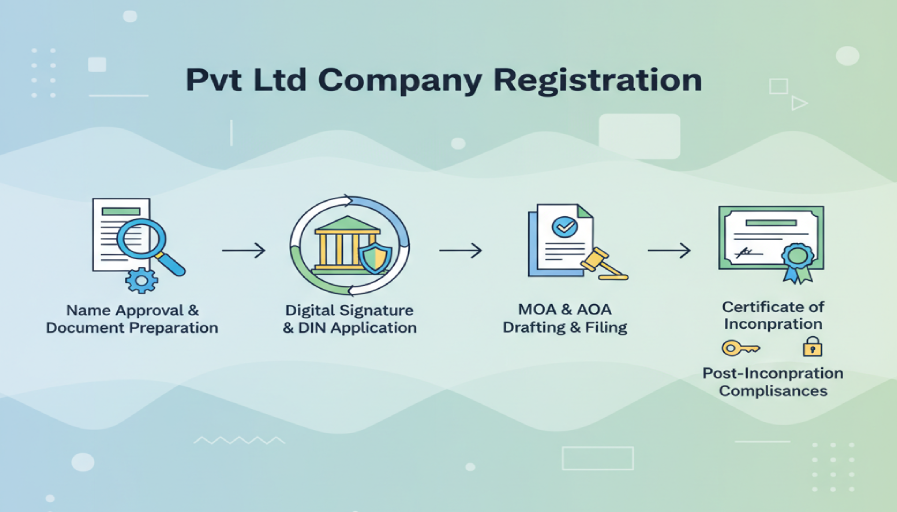
Step-by-Step Pvt Ltd Company Registration Process
-
Step 1: Obtain Director Identification Number (DIN) and Digital Signature Certificate (DSC)
Before you even start thinking about company registration, ensure every single prospective director has a Director Identification Number (DIN) and a Digital Signature Certificate (DSC). These are indispensable for the digital signing of official incorporation documents.
-
- DIN: Anyone aspiring to serve as a company director absolutely requires a DIN. You must apply directly through the Ministry of Corporate Affairs (MCA) website. The DIN application mandates proof of identity and your permanent home address.
- DSC: Consider a DSC as your own personal secure digital key; it definitively verifies your identity and enables you to digitally sign crucial documents. Secure a Class 3 DSC, which is specifically required for company registration. Many authorized certifying bodies across India are fully equipped to issue DSCs.
From my extensive experience guiding numerous clients through their company registrations, I have consistently found that securing both your DIN and DSC early in the process saves a considerable amount of time and proactively prevents potential headaches down the road.
-
Step 2: Company Name Approval
Selecting precisely the correct name for your company is critically important. The name you choose absolutely must be original, fully compliant with the Companies Act of 2013 and accurately reflect your specific business activities. Here is how to move forward effectively.
-
- Name Availability: Diligently check the MCA portal to ensure that your desired name is not already in use or confusingly similar to existing company names.
- Name Application: Officially submit a name approval request using the MCA’s SPICe+ form (Simplified Proforma for Incorporating Company Electronically Plus). You have the option to suggest two names, ranked strictly by order of preference.
- Name Guidelines: Double check that the proposed name does not infringe on any existing trademarks, is decidedly not offensive in any way and does not include any restricted terms as explicitly defined by the government.
I consistently suggest performing a very thorough trademark search before you officially submit your name request. This strategy will help you proactively avoid potential legal problems down the line.
-
Step 3: Drafting the Memorandum of Association (MoA) and Articles of Association (AoA)
The Memorandum of Association (MoA) and Articles of Association (AoA) together constitute the very bedrock of your company. These vital documents comprehensively outline both the scope of your company’s operations and its internal regulations.
-
- MoA: The MoA absolutely must include your company’s legal name, the specific state where your registered office is physically located, the precise goals of the company, the nature of member liability (which must be definitively limited) and the authorized share capital.
- AoA: The AoA minutely details all regulations governing the company’s internal affairs. This includes the specifics of share allocation and transfer, the protocol for meetings, the scope of director authority and the mechanics of dividend payments.
Assembling these mission critical documents demands meticulous consideration and specialized legal expertise. I consistently advise all my clients to proactively seek expert legal assistance to absolutely guarantee full compliance and to fully protect their long term business interests.
-
Step 4: Filing for Incorporation
Once you have successfully drafted both the MoA and AoA, the next required step is to officially file for incorporation directly with the Registrar of Companies (ROC). This crucial task is accomplished via the SPICe+ form located on the MCA portal.
The all in one SPICe+ form streamlines the process by combining company name reservation and actual company incorporation, along with the allotment of DINs, PAN applications, TAN applications, EPFO registration, ESIC registration and even professional tax registration specifically in Maharashtra. Think of it as your own centralized toolkit.
Have these essential documents completely ready for incorporation:
-
- MoA and AoA
- Formal declarations from each director
- Verifiable proof of your registered office address
- Thorough identity and address verification for every single director and shareholder
- Formal consent to act as director (DIR-2)
Accuracy and meticulous attention to detail in your paperwork are absolutely essential to successfully avoid rejection. I always personally conduct a deep dive into all submitted documents before their final submission to definitively ensure full compliance.
-
Step 5: Obtaining Certificate of Incorporation
As soon as the ROC successfully verifies your submitted paperwork, you will promptly receive a Certificate of Incorporation. This document validates your company’s official registration and definitively grants you the legal permission to formally commence business operations. The certificate prominently includes the Corporate Identity Number (CIN), which serves as your company’s unique identification.
Holding the Certificate of Incorporation signifies that you are extremely close to the finish line.
-
Step 6: Applying for PAN, TAN, and Bank Account
Immediately after securing your official Certificate of Incorporation, promptly apply for both a Permanent Account Number (PAN) and a Tax Deduction and Collection Account Number (TAN). These are absolutely crucial for properly managing all tax related responsibilities.
-
- PAN: The PAN is a ten digit alphanumeric number that is formally issued directly by the Income Tax Department. It is absolutely necessary when you are filing income tax returns and for properly handling financial transactions.
- TAN: The TAN is also a ten digit alphanumeric number, and it is specifically required for deducting or collecting tax directly at the source.
Also, take immediate action to set up a dedicated business bank account officially under your company’s registered name. This dedicated account will be used to handle each and every one of your company’s financial transactions.
I strongly advise my valued clients to complete each of these critical steps without delay to ensure that all financial operations run as smoothly as possible.
-
Step 7: Comply with Post-Incorporation Requirements
The Private Limited Company Registration Process does not simply end upon formal incorporation. You are also required to fully satisfy several essential post incorporation requirements, such as:
-
- Appointment of First Auditor: You are legally required to formally appoint an auditor within precisely 30 days of your company officially incorporating.
- Filing of Commencement of Business: Within precisely 180 days of incorporation, you must file a formal declaration directly with the ROC, affirmatively confirming that your company is fully operational.
- Holding Board Meetings: You are legally obligated to hold regular board meetings exactly as mandated by the Companies Act, 2013.
- Maintaining Statutory Registers: This is absolutely non negotiable. Clear examples include maintaining a register of members, a register of directors and a comprehensive register of charges.
- Filing Annual Returns: Each and every year without exception, you must formally submit both annual returns and comprehensive financial statements directly to the ROC.
Failure to strictly meet these essential requirements can potentially trigger significant penalties, and even serious legal action. I proactively offer ongoing compliance support to all my clients, so that I can ensure they successfully meet every single regulatory demand without fail.
Conclusion
Registering a Private Limited Company in India is indeed a multistep process, one that begins with meticulously securing both a DIN and a DSC and then logically culminates with full compliance with all post incorporation requirements. While this process may initially appear overwhelming, fully understanding each distinct step and actively seeking expert advice effectively paves the way for a demonstrably smooth and remarkably efficient process. By diligently following this comprehensive guide, you will feel fully empowered to confidently establish your own Private Limited Company and to definitively build a rock solid foundation for your new business venture right here in India. I personally have witnessed firsthand precisely how a consistently well organized company setup directly results in lasting success, and I remain fully committed to helping entrepreneurs successfully achieve each and every one of their ambitious business goals.